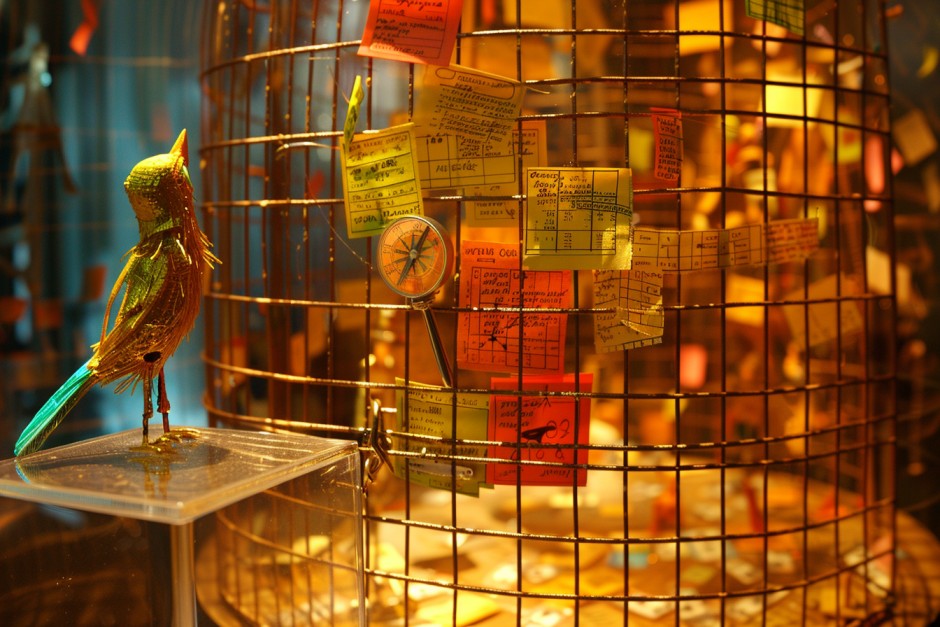
📌 When Agility Becomes a Cage: The Tyranny of Process Worship

🎬 Introduction

Agile was supposed to liberate teams.
Faster iterations. Closer to users.
More learning, less bureaucracy.

But somewhere along the road…
Agility became ritual.
Process became dogma.

We stopped thinking,
and started worshiping the ceremony.


🔄 The Agile Paradox

We’ve seen it before:

  • Daily stand-ups that last 45 minutes
  • Retrospectives filled with silence
  • Teams sprinting without understanding the race

Agility became a checkbox.
A theater.
A safety blanket for control disguised as freedom.


📍Real-world case

In a major European fintech company, the IT team proudly ran five Scrum teams.
Backlogs were updated.
User stories were written.
Burndown charts looked great.

Yet product launches were constantly delayed.
Users reported no significant improvements.
Team morale? Flat.

A deeper review revealed:

  • 30% of stories were rewritten 4+ times due to unclear ownership
  • Stakeholder reviews were box-ticking rituals
  • Teams followed Scrum, but had no shared vision

They were agile in motion, rigid in mindset.


🪞Metaphor: The Sacred Calendar

In some teams, the Jira board is more sacred than the customer’s pain.
Sprint Planning becomes a liturgy.
Velocity metrics are the new commandments.
And the team becomes… priests of a process they no longer question.


🚨 Warning Signs of Process Idolatry

  1. More energy spent on rituals than outcomes
    If retrospectives feel like paperwork, it’s time to pause.
  2. No space to challenge the process itself
    Agile is iterative – including how we do Agile.
  3. Dogmatic use of frameworks
    “We must do it this way” is the death of creative teams.
  4. Low psychological safety, disguised as structure
    People obey the rules but don’t speak up.

🛠️ How to Break the Spell

  1. Re-center on purpose
    Why are we using Scrum/Kanban/XP?
    Does it still serve the team’s mission?
  2. Foster Agile literacy
    Ensure people understand why each practice exists – not just how.
  3. Iterate on the process itself
    Teams should have agency to tweak, drop or invent rituals.
  4. Make feedback loops real
    Feedback isn’t a retrospective note. It’s a daily muscle.

đźš« Avoid These Pitfalls

  • Becoming framework fundamentalists
    No method is universal. Adapt or die.
  • Conflating agility with speed
    Agility is about responsiveness, not acceleration.
  • Measuring what doesn’t matter
    Burnout with perfect velocity is still burnout.

✨ Closing Thoughts

Agility should be a lens, not a cage.
A team that blindly follows Agile rituals may move fast —
but in circles.

The most agile teams?
They ask better questions.
They outgrow their frameworks.

📌 Agile Amnesia: When Teams Forget Why They Started

🎬 Introduction

Sprint. Review. Retro. Repeat.
Another cycle. Another iteration.
But something’s missing.

In many “agile” teams, a strange kind of collective amnesia sets in.
The ceremonies remain. The tools are used.
But the why behind it all gets buried under velocity charts and Jira tickets.

This is what I call Agile Amnesia:
A silent drift from purpose, disguised as high performance.


đź§  What it looks like

  • Teams focused on delivery, not value
  • Dailies become status updates, not collaboration boosters
  • Retros become rituals, not reflection spaces
  • The product backlog grows, but the vision blurs

They are doing Agile.
But they’ve stopped being agile.


đź§© Real case

At a SaaS company, a product team had one of the highest throughput scores in the organization.
But customer satisfaction had dropped 22% over the last quarter.

Why?
They were shipping more features, faster than ever—
But no one had challenged why they were building them.

After interviewing team members, a clear pattern emerged:

“We’re not sure who we’re building for anymore.”
“We just focus on hitting sprint goals.”
“The vision used to excite us. Now it’s just tasks.”

Agile had become a process.
Not a mindset.


🔍 A metaphor: the agile treadmill

Imagine getting on a treadmill to train for a mountain hike.
You walk, you run, you sweat.
But if you never get off the treadmill, you’re just moving without direction.

That’s Agile Amnesia: a team in motion, but going nowhere meaningful.


đź§­ Four signals of Agile Amnesia

  1. No one questions the backlog anymore
    The list is taken as gospel, not as hypothesis.
  2. Velocity is celebrated more than impact
    “We closed 28 story points!” But… did they matter?
  3. Retros lose soul
    If people say “same as last time,” it’s not reflection—it’s fatigue.
  4. Customers vanish from conversations
    If the only mention of the user is during sprint review, disconnection is guaranteed.

🛠️ How to revive the “why”

  1. Reground every sprint in impact
    Start planning with: “What problem are we solving and for whom?”
  2. Bring real stories into the room
    Invite a customer. Read a review. Show a case. Make it human.
  3. Redesign retros as catalysts, not complaints
    Use them to imagine, reconnect, realign—not just fix annoyances.
  4. Kill zombie rituals
    If a ceremony feels dead, stop. Reframe. Reboot. Or delete.

đźš« What to avoid

  • Obsessing over tools
    Tools are containers. Culture is what fills them.
  • Agile theatre
    Stand-ups and Kanbans look nice. But if there’s no ownership or learning… it’s just performance.
  • Pretending “done” means “useful”
    Something can be shipped and still be irrelevant.

✨ Final thought

Agile isn’t a checklist.
It’s a constant act of remembering:
Who are we serving?
Why are we building?
What do we want to learn?

A team that forgets its “why” becomes a team efficient at the wrong things.

🧬 Culture Prototype: Stop Designing Culture Like a Mission Statement

🪜 Introduction

Culture isn’t written. It’s built.
And yet, too many organizations try to “define” their culture the way they define a slogan — clean, aspirational, framed on a wall. The problem is that culture isn’t a sentence. It’s a set of microdecisions repeated under pressure.

If you want to influence culture, you don’t start with words.
You start with prototypes.


📉 The Problem

Let’s face it: the classic approach to shaping culture is too slow and too abstract. You gather executives, pick five values, write a manifesto, maybe print some posters.

Meanwhile, people on the ground are navigating real constraints, unspoken rules, and incentives that contradict those values.

Culture doesn’t live in statements.
It lives in behaviors.
Especially the ones we reward, tolerate, or ignore.


đź§  The Culture Prototype Mindset

Think of culture not as something you define — but something you prototype.

A culture prototype is a deliberately designed experience that tests a future behavior, belief, or interaction in a safe, observable environment. It’s a cultural “mock-up” where you make the invisible visible and invite people to react, reshape and refine.

This changes everything.

Instead of launching culture with a town hall, you start by testing it like a product. You explore hypotheses, observe reactions, iterate language and rituals.

You design culture like a living interface — not a brand guide.


đź”§ Three Practical Prototypes

  1. The Feedback Currency
    Create a prototype week where every piece of feedback must be given in the form of a “coin” — physical or digital — that carries one insight and one appreciation. Then track the flow: who gives most, who hoards, who exchanges. Culture shows up in the economy of attention.

  2. Failure Narratives Wall
    Design a digital (or physical) wall where team members post not just failures, but the narrative about the failure: how they made sense of it, what changed, what still hurts. You’ll notice who dares to go first, who reframes, who hides. That’s the real psychological safety index — not a survey.

  3. Curiosity Permission Slips
    Run a sprint where everyone is required to use 10% of their time to explore something irrelevant to their role, but deeply interesting. The key is not the content — it’s whether people feel they have permission to do so. Culture is shaped by what people feel they can do without asking.


đź§Ş A Real Case

In a European fintech company, leadership wanted to promote a more open and experimental culture. Instead of declaring it, they launched a “Culture Sprint”.

Every week, a new behavior was prototyped:

  • Monday standups began with curiosity challenges.

  • Slack bots celebrated unpolished work.

  • Teams voted on micro-rituals they wanted to test.

By week 4, they didn’t need a new culture statement — they had new habits. Participation rates were over 80%, and managers reported a sharp drop in “silent resistance”.

Culture wasn’t introduced. It was experienced, shaped, owned.


đź”­ A Strong Analogy

Designing culture without prototyping is like writing an app description without building the interface.

It might sound good, but the first click breaks the illusion.


đźš© Pitfalls to Avoid

The biggest risk is theater. Culture prototyping must feel real, not staged.
If participants sense it’s performative, they’ll adapt superficially and withdraw emotionally.

Another trap is over-controlling the prototype. You’re not presenting a finished product — you’re co-designing. Leave room for emergence, even if it’s messy.

And perhaps the most subtle danger: not following up. A prototype without continuity feels like betrayal. Design the next step before launching the first.


🎯 Closing

Culture doesn’t need better definitions.
It needs better experiments.

Culture change starts when we make behavior safe to test, language safe to stretch, and meaning safe to negotiate.

So stop asking what your culture is.
Start asking: what’s your next prototype?

Responsible AI Adoption: Turning Principles into Action

Let’s get real.
By now, most organisations have a slide somewhere that says:
“We use AI responsibly.”
But when you ask what that really means — who decides, how it’s enforced, what gets measured — silence.

Because too often, ethics lives in the policy deck.
đź’ˇ Not in the decision-making flow.

If you want your AI strategy to be more than PR, you need to operationalise responsibility.


đź§  What does that look like?

✔️ Clear criteria for acceptable and unacceptable use
✔️ Decision pathways for when AI-generated output is not used
✔️ Accountability frameworks: who owns which part of the risk
✔️ Diversity in design and testing teams
✔️ Continuous auditing — not just before launch, but post-deployment

👉 Responsible AI isn’t what you say.
It’s what you build — into the system.


đźš« Common pitfalls:

❌ Delegating “ethics” to legal or compliance teams only
❌ Assuming fairness because “the model says so”
❌ Focusing on technical bias but ignoring organisational ones
❌ Confusing transparency with consent
❌ Measuring success by adoption, not by actual impact

Ethics without feedback loops is just branding.


âś… How to embed real responsibility:

  1. Co-design AI governance with cross-functional teams
  2. Include affected users — early and often
  3. Translate abstract principles into decision-making tools
  4. Make responsible use visible, not just stated
  5. Reward people who raise red flags — not just those who deliver fast

đź’Ą Final provocation:

What if the most strategic move you could make this year
was not scaling faster —
but scaling more responsibly?

If you believe ethics isn’t a side note but the foundation of smart AI adoption, tag someone who’s building systems that deserve our trust 🤝⚙️.

Scroll to top